
The Hunger Games: Sunrise on the Reaping
/The official trailer for The Hunger Games: Sunrise on the Reaping dropped on April 13th, and it’s a clear shift. The franchise that blended James Newton Howard’s careful orchestration with curated alt and folk soundtracks has just released a remixed The Who track from 1973 over its first full-length trailer, announcing this isn’t your parents’ Hunger Games. Or, maybe rather it’s your grandparents’ Hunger Games—being as it is a prequel set twenty four years before the original, and the aesthetic definitely leans 70s here.
The song definitely reinforces that aesthetic, while offering an intertextual parallel. “Love, Reign O’er Me,” The Who’s closing track from Quadrophenia (1973), closes the story of Jimmy, a young mod in 1960s Brighton caught in an identity crisis. It’s a close fit for The Hunger Games’ Haymitch Abernathy (Joseph Zada)—the only living victor from District 12 before Katniss and Peeta—whose story we follow here.
The Hunger Games franchise has always had a thoughtful relationship with music since its earliest marketing. The first film’s soundtrack, Songs from District 12 and Beyond, debuted at number one on the Billboard 200 and drew on Appalachian and folk traditions—the Civil Wars, the Secret Sisters, the Carolina Chocolate Drops—grounding the world of District 12 in a real musical geography. The franchise’s sonic foundation has always been folk instrumentation, rooted in the rebellion’s homegrown identity. So, the Who is a pivot. It’s the first time the franchise’s trailer marketing has reached for classic rock bombast rather than folk intimacy or bespoke alt music. Quadrophenia is a concept album about the machinery of identity in a society that expects them to conform and perform and The Hunger Games has always been a commentary on that very notion.
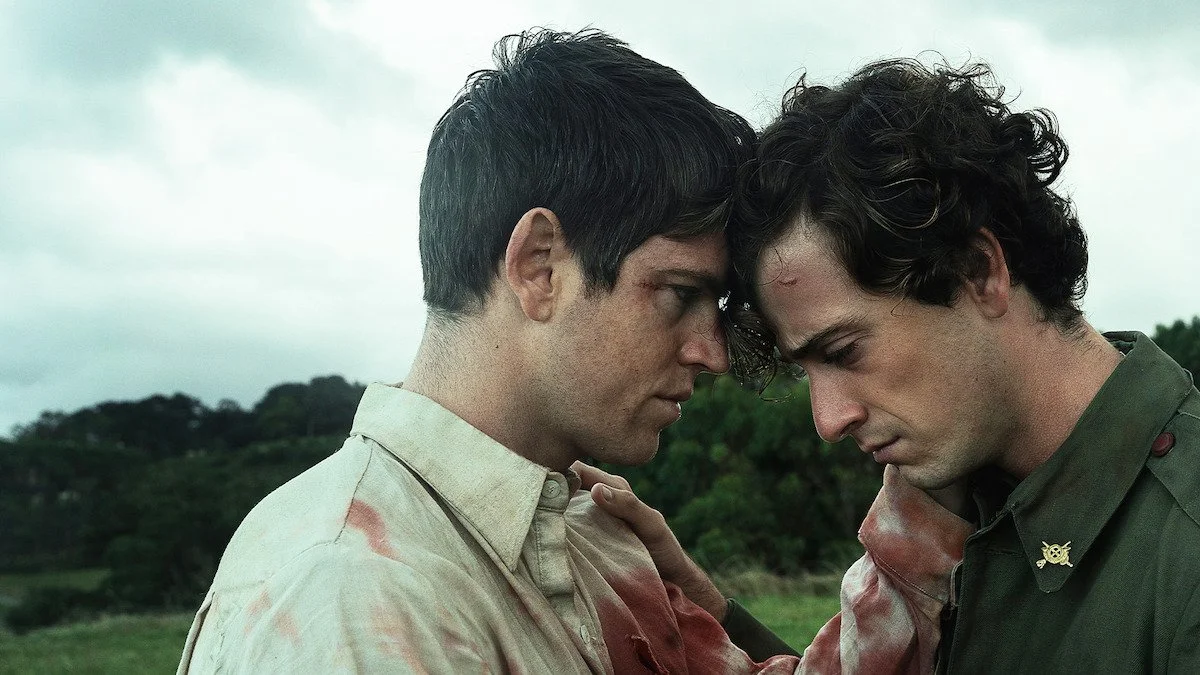
The trailer presents the story of the 50th Hunger Games and the Second Quarter Quell, which required each district to send twice the number of tributes/participants. Joseph Zada plays young Haymitch, and the trailer gives him an early confrontation with Ralph Fiennes’ President Snow. “I bet I know a thing or two about you,” Snow tells him. “You love her and she loves you.” The Capitol has identified its weapon for manipulation early.
What’s striking about using Quadrophenia-era Who here is how deliberately it maps onto the film’s production design: the wide collars, the colour palette, the geometry and architecture. The Quarter Quell in the novel appears to be set roughly in the equivalent of the mid-1970s within Panem’s timeline. Dropping a 1973 anthem over a trailer for a film styled to evoke that decade is a key synch decision.
For much of the first half of the trailer the music is arranged within a generally orchestral bed, focusing instead on world building and dialogue, though those familiar will hear many identifiable facets of “Love, Reign O’er Me”. Quadrophenia bottles working-class anger and spiritual longing in a concept album focused on the teenage experience, since Mod culture was about style as identity, and identity as survival. It transfers pretty clearly onto a story about a kid who knows the system is designed to kill him and dresses up for the cameras until then. Notice how at 1:31 Haymitch’s scream synchs perfectly with Townshend’s as he repeats “reign over me, over me…” (and it’s pretty clear who is reigning over Haymitch here). At 1:52, on-screen gunfire synchs to the beat, followed by clapping matched with epic percussion. It’s an intense amount of synched moments at the height of the trailer.
This edition of the Hunger Games is Haymitch’s story; using The Who’s track reinforces that on multiple levels: the timeline, the aesthetic, the narrative.
The Hunger Games: Sunrise on the Reaping reaches theatres November 20th.
— Curtis Perry