The Legend of Zelda: Ocarina of Time
/Music has always been a central facet of the Legend of Zelda series, and the seminal N64 entry, Ocarina of Time, is universally regarded as a masterpiece in gaming. It’s a story, in essence, about growing up and reckoning with the passage of time. As such, the company surely needed a particular source of courage—perhaps matching the series’ famously silent protagonist, Link—to undertake the task of potentially messing with a generation of gamers’ fondest memories.
After the Switch logo and its iconic “snap” sound logo, the landscape settles. Around 0:06, the ocarina enters with “Zelda’s Lullaby,” its opening rising third and subsequent fall whisking the audience to the land of Hyrule. We see reimagined locales such as Lon Lon Ranch and Lake Hylia, delivered in gorgeous detail that surpasses the dreams of the youth who first saw them twenty-eight years ago. Indeed, just as Hollywood studios have increasingly mined the nostalgia of the public with reboots and sequels, we’re well into a similar practice with video game studios—take for example the remakes of 90s classics Resident Evil and Final Fantasy VII. Beyond the nostalgia, there’s an argument to be made for updating these classic titles for the technical capabilities contemporary video game consoles now offer. This includes the music: In 1998, Nintendo opted for a cartridge format that at the time could not hold the data required for high fidelity recorded audio. Now, of course there is no such constraint, and the orchestral music that composer Koji Kondo intended can now breathe unfettered. The music, lovingly unchanged in content but instead brought to full realization, anchors the audio viewer in an experience that visually has changed much more.
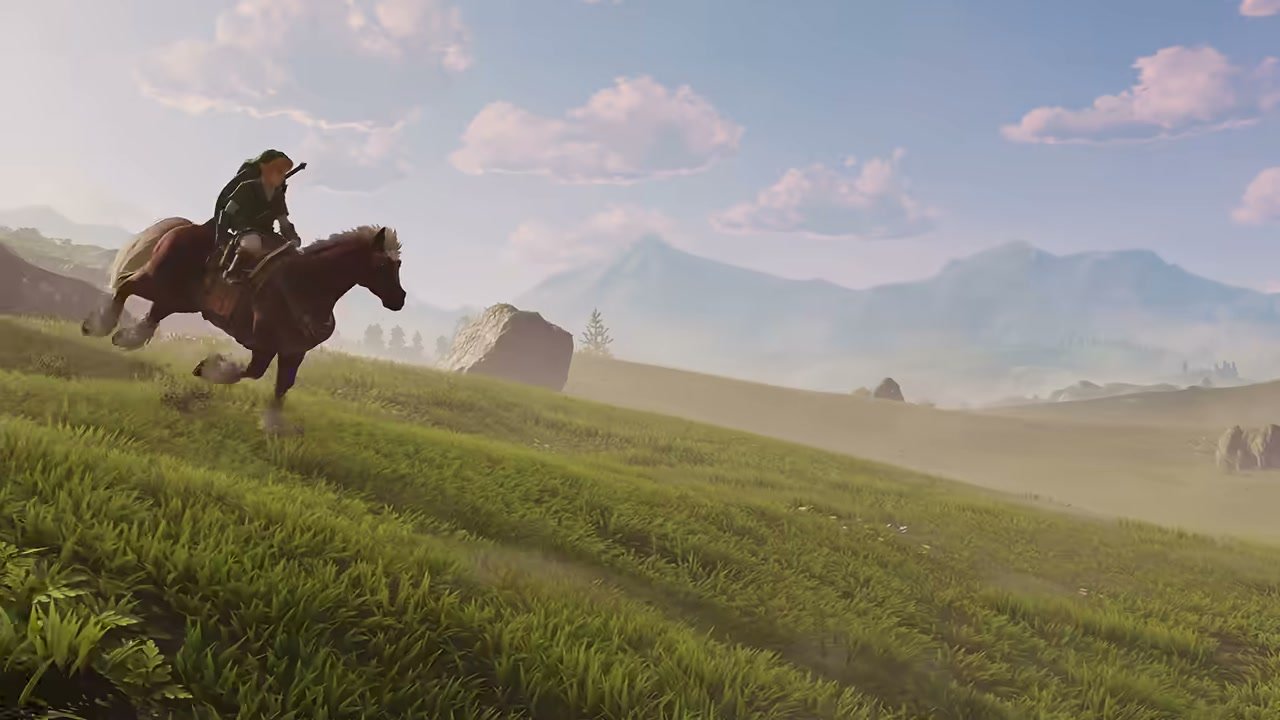
Around 0:22, the orchestra expands the accompaniment as the picture cuts to a moonlit field. Link and Epona appear against that wider backdrop; the ocarina’s intimacy gives way to an orchestral scale suited to the wider landscape, mirroring the relationship between player and environment.
At 0:41 we shift to a more energetic orchestral cue, moving from establishing the setting to gameplay—a common editing trope for video game trailers. Towns, enemies, climbing, and combat follow, with the longer opening views replaced by a much denser sequence of activities. The score lends continuity across the montage.
At 1:45, the music relaxes over a particularly apt image: Sheik with a harp, followed by Link playing his ocarina; music-making itself is briefly brought into view. Then we hear another primary character in the story, Saria, whose first sentence begins around 1:47 as an audio bridge before the cut to her at 1:49. It’s an effective introduction to the remake’s newly voiced cutscenes.
Saria, a childhood friend of Link’s, reflects on him leaving the forest, promising her friendship “forever and ever”—and this works beyond the immediate conversation, acting as meta commentary about the relationship between fan and franchise. Ocarina of Time is simultaneously a relic left behind as much as it is enduring. Next we encounter more of the cast, with Zelda, Darunia, and Ruto following in quick succession, making it a new introduction to an old cast, especially through the voice acting.
We take another turn at 2:13, with Ruto’s laughter and the preceding music giving way to a dark orchestral passage, black frames, and series villain Ganondorf’s looming horse. The command at the drawbridge around 2:31 and Ganondorf’s claim to the Triforce around 2:38 centre exposition through dialogue for a moment.
Finally, at 2:52 the music takes a triumphant turn, and the montage narrows to Link approaching the iconic Master Sword. This carries into the title reveal.
There’s nothing altogether surprising about the content of this trailer—and arguably, nor should there be. Nintendo’s play here is to studiously respect the source material, knowing the hearts—and wallets—of a generation (or two) of fans are coming in with strong memories and expectations. That being said, there’s an art to faithful reinterpretation. There are some brand-new elements—such as the characters’ voices—and the trailer does well in its deliberate pacing to guide the audio viewer through it all, precisely targeting and highlighting a few key moments in the game for maximum nostalgia.
The Legend of Zelda: Ocarina of Time releases November 5 on Nintendo Switch 2.
— Curtis Perry