
How to Rob a Bank
/A little career advice goes a long way in the second trailer for David Leitch’s How to Rob a Bank. An instructional voice takes us through the familiar milestones of education, employment, and advancement—while the visuals, music, and occasional bit of dialogue undermine the idea, in an exercise of extended irony. Nicholas Hoult and his accomplices have found an endgame of sorts in the influencer economy: rob banks, broadcast the results, build an audience… profit? The trailer’s music captures both the stilted, absurd nature of the ploy and its insistence, lurching towards ridiculous success.
The music—perhaps the best, most current music up to such a task—is Angine de Poitrine’s “Sherpa”, whose appearance unsurprisingly dominates the YouTube comment section of the trailer. The pride of Saguenay, Québec, the duo pairs microtonal guitar with percussion, an apt choice for Hoult and co. Recurring motoric musical figures help pull together a montage replete with dialogue and action, with the narrator treating each step as perfectly reasonable while the lopsided groove—ultimately 4/4, but polymetric nonetheless—reminds us of the epic ruse.
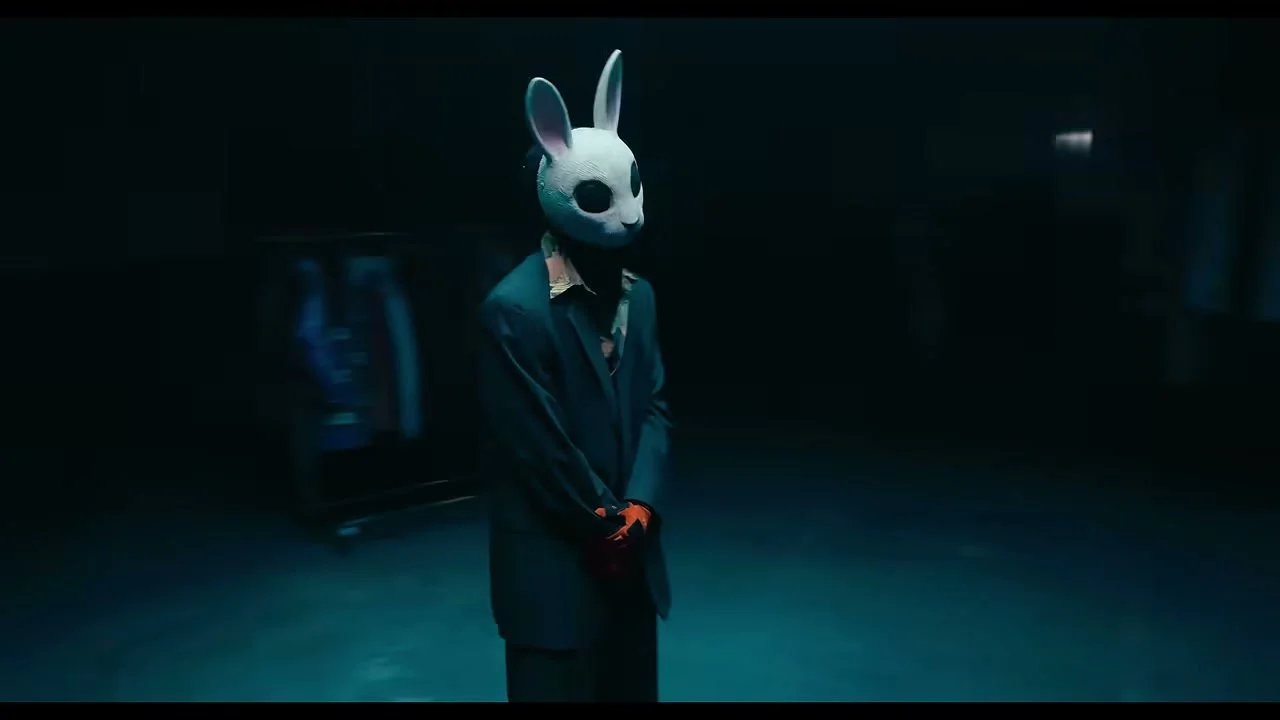
By 0:06, the tutorial is underway. Its promise of a rewarding career accompanies an armoured-truck robbery; the contradiction is there before the narrator even gets to education and student debt. At 0:18, advice to “dress for success” leads into a parade of oversized animal masks, followed by a recommendation of conservative colours over loud outfits. We get our first comedic break in the music at 0:31, with the jingle of a shop door as an elderly customer shuffles in and cuts Angine off. As if in response, when the music resumes, we get the introduction to the crew’s YouTube channel.
At 0:44 we have our second pause, on the line “didn’t your bank, like, screw over a lot of people?”—reinforcing a somewhat lighter-hearted, Robin Hood aspect of the film. This is borne out at 0:49, as we see the robbers give back to struggling families—the narrator talks of “confidence and a sense of purpose,” showing us how else such purpose could be achieved. The irony continues—the reassuring language for a conventional career, to some extent anyway, now justifies crime.
The farce extends at 1:04, when a motorist being carjacked says “Is this How to Rob a Bank? … I love your show!”—followed by a simple “thanks for watching.” It’s an interesting commentary on parasocial relationships—how a fan can accept having his car confiscated in the name of the greater purpose of the channel, and how entertainment can mix with a broader mission of online social good. More than any of that, however, it points to the absurdity of some aspects of contemporary life and the “creator economy.” Soon enough, we see how an online movement can spill offline (as it often does)—followers, well, follow the crew’s lead and turn to anarchy.
At 1:48, Hoult takes his turn as instructor, telling kids to “do try this at home.” Indeed, the intensely hypnotic nature of Angine de Poitrine’s music almost compels one to see the whole scheme as completely reasonable.
How to Rob a Bank opens in theatres November 13, 2026.
— Curtis Perry