
The End of Oak Street
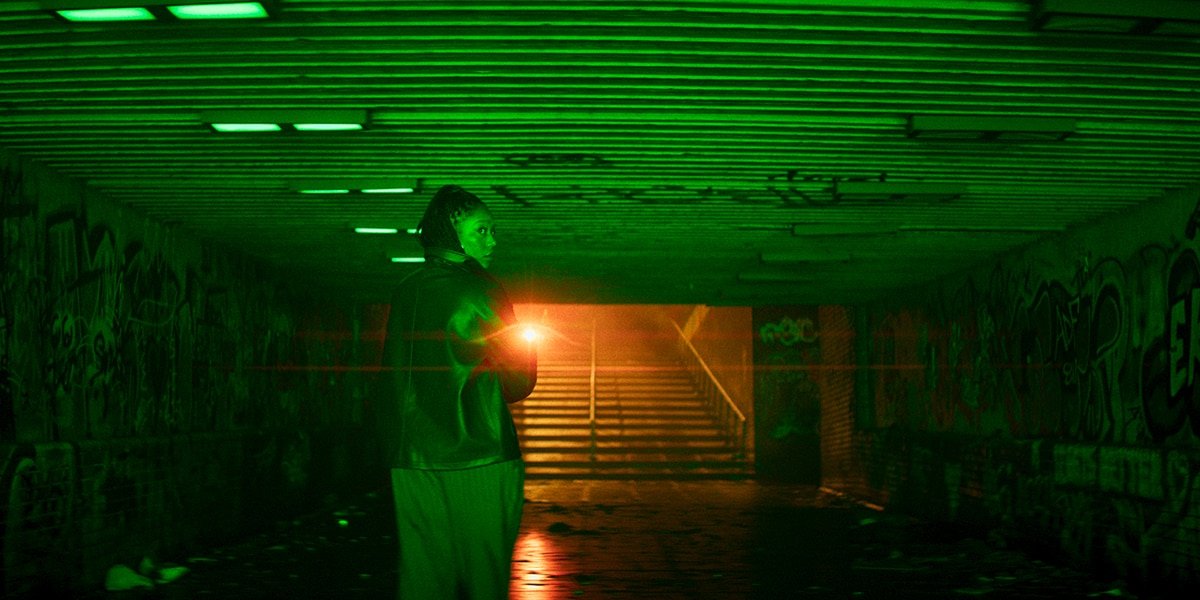
/Directed by David Robert Mitchell (best known for the critical acclaimed It Follows), The End of Oak Street adds to a recent crop of more original ideas coming out of Hollywood—we’re thinking, of course, of the runaway success to Backrooms.
It doesn’t take long in the trailer for the editors to indulge in some audiovisual counterpoint; at 0:30 we hear the distinctive voice of Billy Joel—“I don’t need you to worry for me ‘cause I’m alright.” Things are clearly not alright. His voice ironically reverberates a cappella in a mix that sounds distant, as a radio is tuned on screen—not quite a diegetic match, but the suggestion is there. The placement serves a dual purpose of eliciting dramatic intrigue while also suggesting, along with the use of the vintage radio, that this is a period piece set around the 1980s. Furthering the point, we hear Joel saying he’s alright in the next line as one of the protagonists, much further up the mix, says, “what the hell is that?”
At 0:40 we get a synth tone that’s entirely discordant to the melody of the song, tonally twisting it. At 0:47 we get a modally mixed string ostinato to imbue an epic, vaguely sci-fi sensibility, with a horn sliding downward to bring the horror element back in at 0:56. An audiovisual blackout at 1:04 except for the sounds of some offscreen creature follows epic percussion.
At 1:05 we’re clearly in the next segment, focusing more on action, with epic percussion to match, and we get an unobstructed view of what turns out to be dinosaurs. Billy Joel comes back in at 1:14, defiantly singing “I don’t need you to worry for me cause I’m all right,” now with an epic arrangement infused. Clearly, the ironic pairing of this track mirrors the premise of the film—domestic bliss transplanted, somehow, into the prehistoric wild. The track takes on a different tone at 1:25 when Joel sings “I don’t care what you say anymore / this is my life”—tracking a little more unironically to the protagonists’ determination for survival. Note the shattering of an entire bay of windows at 1:30 used as an off-beat for the soundtrack—an effect that is slightly humorous for how ridiculous it is, bringing serious destruction to what we think of as a fairly laid-back tune. The cat poking its head out following this scene underlines the sense of humour and even whimsy as an undertone for the trailer.
“Leave me alone” Joel emphatically sings, as the snarl of a dinosaur threatens to overtake him in the mix—the last syllable extended as a clever way to prolongate the cadence and give us a sonic through-thread for the final action montage. A small discussion between the family offers a little more insight into the personalities of the family under duress before we’re treated to one more spetacular display of dinosaurs in suburbia, notably with some jarring audiovisual blackouts at 1:55, 1:58, 2:00, and 2:03 that are aggressive, but work as such. One more refrain from Joel plays us out with the title card at 2:05.
Overall, it’s a well though out and extensive use of an existing song in an epic music arrangement, drawing out the multifaceted moods of the film—thrilling, horror-based, with hints of action-adventure and comedy. It’s theatre of the absurd, with a focus on entertainment.
The End of Oak Street arrives in theatres August 14th.
— Curtis Perry